Issue 032 · In-Person Presence
--:--:-- PT
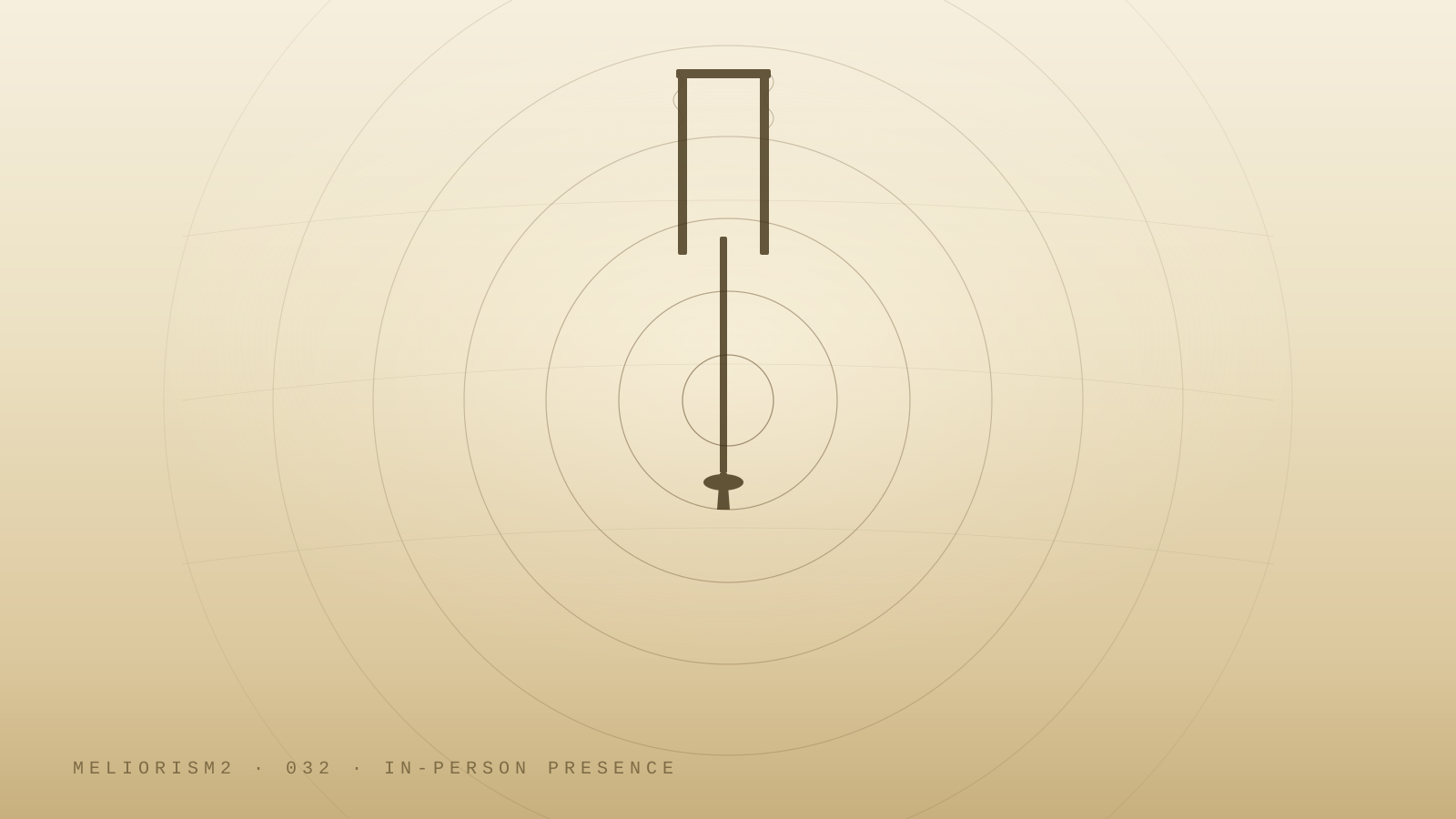
A tuning fork centered in a field of concentric resonance rings — the orchestra's reference frequency rendered as standing-wave geometry.
Issue 032
In-Person Presence
The Tuning Fork
Mon · 06 / 01 / 2026 · The Tuning Fork · Format: The Tuning Fork
The Tuning Fork
Before a room can tune to anything, something has to be the reference frequency. The practitioner walking in is that frequency, whether they read themselves or not.
Weather · Resonance
§ 00 · The Signal

The instrument is the reference, not the room.

An orchestra tunes to a single oboe. Eighty musicians, four families of instruments, a hall designed to bend sound — and the entire calibration of the next two hours runs through one wooden tube playing one note: A above middle C, 440 cycles per second.

Not a chord. Not a chosen ensemble. One pitch, one source, every other instrument matching to it.

The reason is not ceremony. A chord cannot be a reference frequency because there is nothing inside a chord to match against — each instrument would tune to a different note of it and the room would drift. The reference has to be one pitch every other instrument can hear and produce. The oboe is chosen because its reed is fixed; it cannot be adjusted mid-note the way a string can. Whatever the oboe sounds is what the rest of the room becomes.

90-Second Signal

The practitioner walking into the room is the room's tuning fork. The reference frequency for the next two hours is whatever the practitioner brings through the door, read or unread. Calibration is not what happens after the room starts being loud. It is the thirty seconds before contact, when the reference is set.

Weather · Resonance

A room that has already begun to tune. Not the silence before a piece; the alert quiet of attention finding its pitch. Practitioners arrive at this atmosphere when the body is read, the breath is named, and the next door is the room itself. Whose clients are in this weather right now?

§ 01 · The Phenomenon

The body is already reading before the mind decides what to read.

A practitioner walks from the parking lot to the door. Eighty seconds. In that interval, the autonomic nervous system has already taken hundreds of readings — heart rate variability, skin conductance, breath rhythm, gut tone, the angle of the shoulders against the cold air — and produced a state. That state is what walks through the door. It is also what the room will tune to.

The mind has not yet decided what kind of session this will be. The body has already decided what frequency it is broadcasting.

Stephen Porges, who built the polyvagal model of the autonomic system over thirty years, calls this layer neuroception — perception below the level of conscious awareness, running continuously, looking for safety or threat. It does not wait for the mind. It does not ask permission to broadcast. By the time the door opens, the practitioner's neuroceptive state is already in the room.

Other nervous systems read it without anyone naming the reading. A child whose mother is unread but tense will not be calmed by the words everything is fine. An adult walking into a session with a practitioner whose body says I am holding something I have not put down will track that, and respond to it, no matter what the practitioner says next.

The orchestra is tuning. The oboe has already sounded.

The Mechanism, in One Line

The room cannot tune to a frequency the practitioner cannot read in themselves. The work is not adjusting after the session starts. It is hearing the A before the door opens.

§ 02 · The Evidence

Four lines of work converging on one finding.

The claim that the practitioner's read state is the room's reference frequency is not a metaphor borrowed from music to dress up a feeling. Four independent research traditions arrive at the same finding from different directions.

Porges · Polyvagal Theory · 2011

Porges identified a third branch of the vagus nerve — myelinated, ventral, evolutionarily recent — that runs continuously and reads the social environment for cues of safety and threat. He named the process neuroception: perception below awareness. Critically, neuroception is bidirectional. The practitioner's own ventral state is broadcast through micro-expression, vocal prosody, breath, and posture, and is read by every other nervous system in the room within seconds. The room tunes to the practitioner's ventral signal before any conversation begins.

Damasio · Descartes' Error · 1994

Damasio's somatic marker hypothesis argued that the body keeps a running ledger of physiological state, and that ledger informs every decision the mind believes it is making rationally. The practitioner who has not read their own somatic markers before walking into a room is making facilitation choices on data they do not know they are using. The room will read the markers that the practitioner has not.

van der Kolk · The Body Keeps the Score · 2014

Van der Kolk's central claim — built on three decades of trauma research at the Boston VA — is that the body retains a record the mind cannot reach. Interoception, the practice of reading the body's own internal signals, is not a wellness technique. It is the substrate of accurate self-knowledge. A practitioner without interoceptive practice is broadcasting a state they cannot describe and that the room will nevertheless tune to.

Helmholtz · On the Sensations of Tone · 1863

Helmholtz worked out the physics of sympathetic resonance: a sounding body causes other nearby bodies tuned to the same frequency to begin sounding without being struck. Sympathetic strings on a sitar, sympathetic vibrations between piano strings — they are not metaphors. They are the physics of bodies in proximity. Two nervous systems in the same room are sympathetically coupled. The one that arrives with the steadier reading sets the pitch.

Four lines, one finding. The practitioner's read state is the room's reference. Calibration is not a wellness routine. It is the act that makes everything else accurate.

§ 03 · The Tuning Procedure

Three readings, thirty seconds, before the door.

This is not introspection. Introspection asks what do I think about how I feel? Tuning asks what is the body reading right now, without interpretation? The difference is critical. Introspection adds a layer between the practitioner and the data. Tuning removes one.

The procedure has three readings and takes about thirty seconds. It is done before the door — in the parking lot, the stairwell, the hallway, the breath after closing the laptop. Not as a wellness ritual. As calibration.

Reading 1 · The Diaphragm

Place a hand below the sternum and exhale slowly. Note where the breath stops without forcing it down. High in the chest is one reading. Low into the belly is another. There is no correct answer — there is the reading. Whatever pitch the diaphragm is at is the pitch the room will tune to in the first minute.

Reading 2 · The Jaw

Notice the position of the tongue against the roof of the mouth, and the tension at the masseter where the jawline meets the ear. A held jaw produces a constrained voice, and constrained voice carries threat at the neuroceptive level even when the words are warm. The reading is not relax. The reading is what is the jaw doing right now, named, before walking in.

Reading 3 · The Field

Step back from the close horizon — the laptop, the phone, the inside of the windshield — and let the eyes settle on the widest available depth of field for a count of four. The orienting response of the optic nerve registers safety in the periphery before the cognitive system catches up. This is the move that converts arrival energy into present-tense readiness without sedation.

Three readings. Thirty seconds. The output is not a decision about how to facilitate. The output is a known reference frequency. The room will still tune to whatever the practitioner walks in with — but now the practitioner can hear the pitch they are sounding.

§ 04 · Edge Cases

When tuning is not available, or not enough.

When there is no parking lot.

The session is virtual; the practitioner has been on calls for four hours; the room arrives in fifteen seconds. The procedure does not require a parking lot. It requires the act of taking the three readings before contact, wherever that contact begins. In a Zoom waiting room. In the moment between closing a tab and opening the next one. The container for tuning is whatever interval exists, not whatever interval would be ideal.

When the room is louder than you.

The practitioner walks in calibrated. The room has already been escalating for ninety minutes before arrival — a senior leader in a sustained state of activation, a grieving family, a cohort whose previous session ended in rupture. The tuning fork's frequency does not erase the room's existing state. What it does is provide one steady reference in a noisy field, and bodies in the room can sympathetically couple to it over time if it stays steady. Steady, not loud. The mistake here is matching the room's volume to be heard. The tuning fork is heard because it does not match — it persists.

When tuning to your own pitch fails the room.

The practitioner's read state is ventral, regulated, open. The room is in grief. Walking in calibrated to a regulated state and broadcasting everything is fine here reads, to the bodies in the room, as not being met. The fix is not to abandon tuning. It is to take a fourth reading — what is the room's state, before the work begins? — and to tune the practitioner's signal toward presence with that state, not against it. Sympathetic resonance requires the reference to be hearable from where the room is, not from where the practitioner wishes it were.

When the practitioner is the one in grief.

Some sessions cannot be walked into. The tuning procedure also produces the data needed for that decision — when the diaphragm cannot reach below the sternum and the jaw cannot release, the reference frequency the practitioner would set is one no one in the room should have to tune to. The right move is to cancel or hand off, and the tuning procedure made that information available before the door, not after the damage.

§ 05 · The Roots

The lineage behind the procedure.

The tuning procedure is not a new technique. It is a folding-together of four older bodies of work, each of which named part of the mechanism.

The earliest is Hermann von Helmholtz, whose 1863 treatise on the physics of musical tone established that sympathetic resonance is a physical fact, not a metaphor. Helmholtz worked out why two pianos in the same room hum at the frequency of a struck note — the un-struck strings are tuned to the same pitch, and the air carries the vibration. The principle generalizes. Bodies in proximity are coupled. Frequencies travel.

Ernst Chladni, eighty years before Helmholtz, made the geometry of resonance visible: drawing a violin bow across the edge of a sand-strewn brass plate produced standing-wave patterns — the sand collecting along the nodes where the plate did not move, the patterns themselves a map of the plate's invisible frequencies. Chladni's plates were the first time a vibration was rendered as a shape. The principle the practitioner enacts is the same: an invisible frequency, made visible by what it organizes around it.

Stephen Porges named the neurophysiology. His polyvagal model, developed in the late twentieth century, identified the ventral vagal branch and the continuous neuroceptive process that broadcasts the practitioner's state into the room without permission and reads other states without conscious effort.

R. Murray Schafer, composer and acoustic ecologist, wrote in The Soundscape (1977) that every environment has a keynote — a continuous background frequency the inhabitants stop hearing but cannot escape. The practitioner is the keynote of the session. The room organizes around what it stops noticing in the practitioner's presence.

Pauline Oliveros, late in life, distilled the operative move into a phrase: deep listening — listening to everything at once, the wide-band reception that is the precondition for participating in any soundscape rather than imposing on it. Oliveros's practice is not separable from a facilitation move. They are the same move, in two registers.

Helmholtz gave the physics. Chladni made the shape visible. Porges named the wiring. Schafer named the keynote. Oliveros named the practice. The tuning procedure assembles them into thirty seconds the practitioner can run before the door.

§ 06 · Application · Pitch-Match

Read the body. See the broadcast.

The agitator interaction for this issue is a pitch-match. Take the three readings from §03 quickly — diaphragm, jaw, field — then choose the option below that most accurately names the dominant frequency you are about to walk into the next session with. The readout names what the room will sympathetically tune toward in the first minute, and the move that will keep the reference hearable.

Reading · Diaphragm
Reading · Jaw
Reading · Field

What Would You Do

It is 2:14 PM. The standing 2:30 with the cohort starts in sixteen minutes. The last meeting ran over by twenty-two minutes and the client cancelled and rescheduled twice. The room is six people you have worked with for nine months; trust is real; today's topic is a structural conflict the senior member has been protecting against naming for two sessions. The walk from this desk to the room is forty seconds. You can feel a held jaw, a high diaphragm, and a field that has narrowed to the inside of the laptop bezel.

Response · Run the procedure, then enter

Close the laptop. Stand. Take ninety seconds, not thirty — the field has narrowed enough that one orienting exhale will not unwind it, and the jaw will not release on the count of four. Walk the long way to the room. Sound the A you can actually sound: not regulated, but read. The cohort tunes to practitioner who knows what state they are in, which is a different reference frequency than practitioner who is fine, and it lets the senior member name the conflict because the room is not asking him to perform calm. The move is naming the state, not erasing it. The practitioner cannot give the room what is not in the body, but the practitioner can give the room an honest reading, and an honest reading is the reference frequency a room can sympathetically tune to.

The wrong move is to push through the door at 2:29 with the high diaphragm unread and an apology already drafted for being scattered. The cohort will tune to the apology — to practitioner who is failing to be ready — and the room will spend its first ten minutes managing the practitioner's state instead of the conflict it convened to address. The tuning fork sounds a pitch the orchestra inherits. Whatever it sounds is what the next hour becomes.

Sources

Porges, Stephen W. The Polyvagal Theory: Neurophysiological Foundations of Emotions, Attachment, Communication, and Self-Regulation. W. W. Norton, 2011. — Establishes neuroception as continuous, bidirectional, and below the threshold of conscious awareness. The ventral vagal complex broadcasts and reads social-engagement cues independent of cognition.
Damasio, Antonio. Descartes' Error: Emotion, Reason, and the Human Brain. Putnam, 1994. — Somatic marker hypothesis: the body's running physiological ledger informs every decision the mind frames as rational. Used here to account for why an unread practitioner state still drives facilitation choices.
van der Kolk, Bessel. The Body Keeps the Score: Brain, Mind, and Body in the Healing of Trauma. Viking, 2014. — Interoception as the substrate of accurate self-knowledge. Three decades of trauma research at the Boston VA establishing that the body retains records the mind cannot reach.
Helmholtz, Hermann von. On the Sensations of Tone as a Physiological Basis for the Theory of Music. Originally published 1863; translated by Alexander J. Ellis, Longmans, Green, 1885. — Physics of sympathetic resonance: a sounding body causes other bodies tuned to the same frequency to vibrate without being struck. The mechanical substrate of the metaphor.
Schafer, R. Murray. The Soundscape: Our Sonic Environment and the Tuning of the World. Destiny Books, 1977. — Concept of the keynote: the continuous background frequency the inhabitants of a soundscape stop hearing but cannot escape. The practitioner as the keynote of the session.
Oliveros, Pauline. Deep Listening: A Composer's Sound Practice. iUniverse, 2005. — Distillation of wide-band reception as a practice. Listening to everything at once as the precondition for participating in a soundscape rather than imposing on it. The operative move the tuning procedure enacts in thirty seconds.
This issue was researched and composed on Ramaytush Ohlone land.
§ 07 · The Delight

The Brass Plate That Drew Its Own Frequencies

In 1787, in the laboratory of a German physicist who had also studied law because his father had insisted on it, a brass plate became famous by holding still.

Ernst Chladni had been working through a problem that had no name yet: invisible vibration. He could hear that a violin string sounded a pitch, and he could feel that a plate of metal hummed when struck — but the actual geometry of the vibration, the shape it took inside the material, was unobservable. The frequencies of the world were a kind of dark physics. Audible, present, but uncalibrated.

Chladni's move was to spread fine sand across a horizontal brass plate, then draw a violin bow across one edge. The bow set the plate vibrating. The sand did not vibrate. The sand collected along the lines of the plate that did not move — the nodes, the still places between the standing waves.

The pattern that emerged was a map. Cross-hatched, geometric, exact. A single pitch produced one figure. A different pitch produced another. The same plate, struck at different frequencies, drew different geometries in sand. Chladni's plates made vibration visible — not by capturing the moving parts, but by revealing the still places they organized around.

What the figures showed was that an invisible frequency was already a shape. The sand only made it legible. The plate had been resonating all along, with its nodal lines and antinodes — Chladni's contribution was the medium that let the pattern be read.

The same is true of the practitioner. The frequency is sounding before the door opens. The body is reading it, the room will tune to it, the work of the next hour will be organized around it. The tuning procedure is a small handful of sand, drawn across the body's surfaces, that lets the practitioner read the pattern that was already there. The work is not generating a frequency. It is finding what the body had already been broadcasting, and noticing the shape.

Chladni published his plates as Entdeckungen über die Theorie des KlangesDiscoveries on the Theory of Sound — in 1787. Goethe, who was an amateur scientist as well as a writer, kept a copy. So did Napoleon, who summoned Chladni to demonstrate the plates personally and offered a prize, partially funded by the French state, for whoever could write the mathematics that explained them. The mathematics took until 1909 to fully arrive. The plates, in the meantime, kept doing what they had done from the first demonstration: holding still in patterns that made the invisible legible.

The practitioner's body is the plate. The thirty seconds before the door is the sand.
§ 00 · THE SIGNAL
HOME