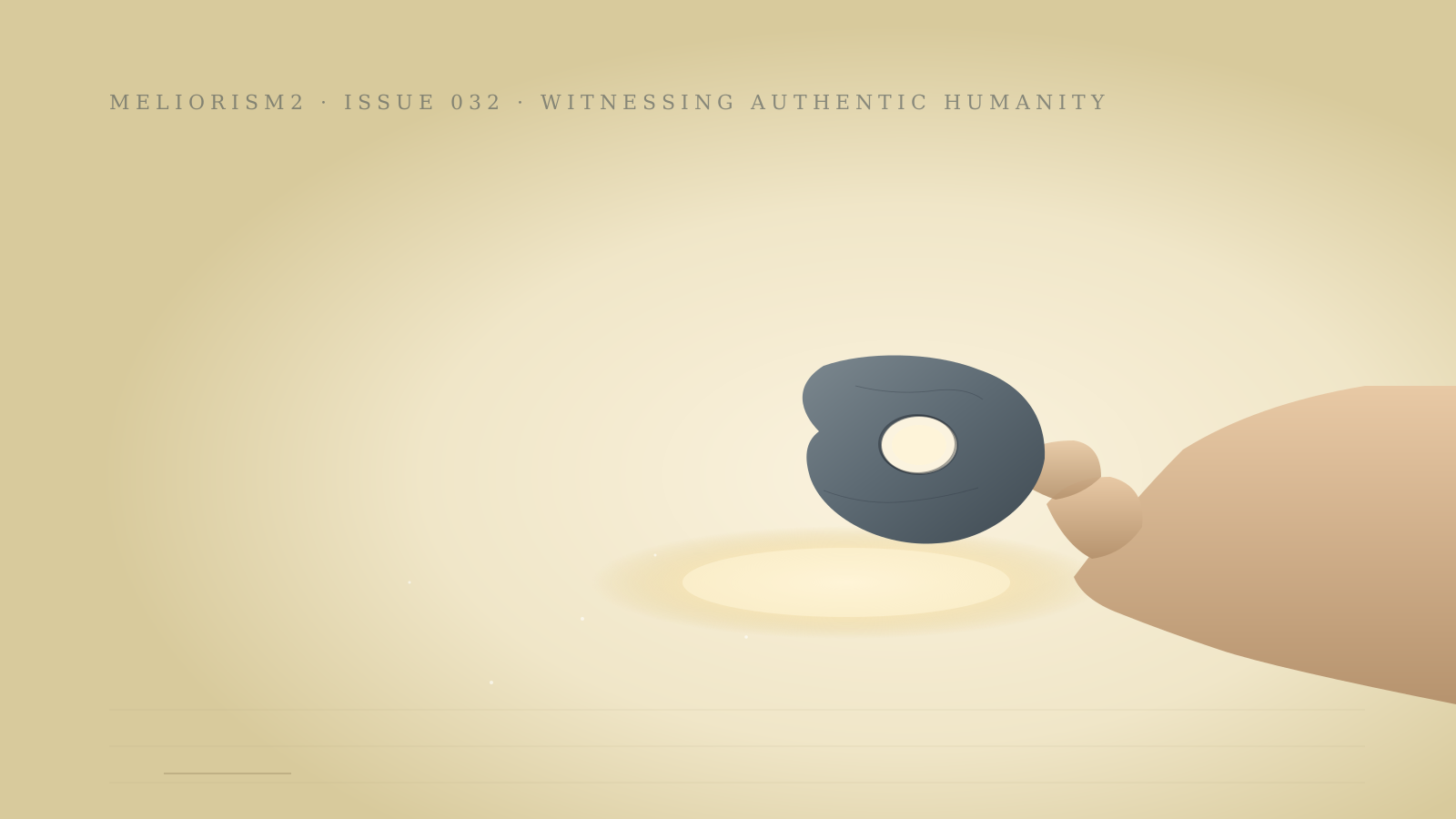
A coastal stone with a hole through it has been the practitioner's tool for a thousand years. The platforms now selling "session insights" are teaching practitioners to stop trusting the eye that already learned to use it.
A practitioner walks into a session and within four seconds knows three things she could not have known. The client's shoulders are higher than last week. The room smells different — colder, somehow, even though the heat is the same. There is a sentence in the back of her mouth she did not plan to say. The session has not begun. The instrument is already running.
This is not intuition, which is the wellness-industrial brand name for what cannot otherwise be sold. This is apprehension — the right hemisphere's pre-categorical read of a room, faster than language, older than the words for what it is doing. Iain McGilchrist names it directly in The Master and His Emissary [5]: the right hemisphere meets the world first, holistically and in context, before the left hemisphere catalogs anything. The practitioner's first read happens before the categorical mind has caught up. This is a feature, not a glitch.
John Berger wrote it more simply in 1972: "Seeing comes before words. The child looks and recognizes before it can speak." — Ways of Seeing, p. 7 [4]. The practitioner is a child who never stopped — the room enters the eye before the eye is told what is in the room. Every coach, every facilitator, every aqua-aerobics instructor with a twenty-year-old's body still in the locker room knows this. You walked in and you knew. You have always known.
A hagstone is a coastal stone with a hole through it. The hole is made by water, usually over decades — a pebble lodged in a softer matrix, worn through. Sometimes by a marine worm. Never by a human hand. That is the requirement that matters: the aperture is found, not made. Pliny the Elder mentions them in his Natural History (77 CE) — "ovum anguinum," the serpent's egg — as a Druidic charm. They sit in 18th-century Cornish midwife drawers. They were strung above stable doors to keep horses from being "ridden" at night. They were carried in the pockets of women who knew things they were not supposed to know.
What the hagstone did, in every century it appeared in, was the same thing: it gave the carrier a deliberate aperture smaller than the eye. To look through it was to filter. To filter was to refuse the velocity of the surrounding visual field. It was a practice of slowness made portable — a thousand-year-old design for the same instrument McGilchrist named in 2009. The right hemisphere apprehends; the aperture refuses everything that is not the apprehension. The stone is the structural equivalent of holding your breath.
This matters because the practitioner is being sold the opposite. The aperture is being widened, by force, by the platform. The eye is being trained to see everything at once, with a confidence score attached to each thing.
Here is how it works in a room. Maya is a coach in a Pacific Heights converted carriage house. Her practice is paid for by Devon's employer — a midsize tech firm — which recently rolled out an "Optional But Recommended" desktop application that listens to coaching sessions and produces a weekly "Client Sentiment Report" for HR. Maya was given a small honorarium for "providing feedback during the pilot." She has not yet decided what she will say.
Devon opens their fourth session with a sentence that has been carried through a door: "I've been told I'm 0.3 standard deviations above average for emotional volatility. That's what HR said." Then Devon laughs. The laugh is the kind that gets used as evidence. Maya knows immediately — the right hemisphere knew, in the first second after the sentence — that Devon's laugh is a survival adaptation, not a confirmation of the metric. The metric is wrong. The laugh is the proof.
The AI-empathy product disagrees. The platform's transcript will register positive valence shift, +0.18, 09:04:12, and Maya's session notes will be audited against that timestamp. Devon's volatility score will be revised upward at the end of the quarter, because Devon's laugh trained a model — built on the bodies of two hundred million subjects who do not know they are training it — that volatility is the thing that laughs when confronted with its measurement.
What is being monetized is not Devon. What is being monetized is Maya's right hemisphere — that first-second read she just did — repackaged as a confidence score that the platform's enterprise client uses to make decisions Devon will never see. Devon's authentic ambiguity is the raw material. The practitioner's pre-linguistic apprehension is the refining mechanism. The compliance score is the sold product. The whole loop runs without consent from either of the people in the room.
This is the agency theft. It does not look like theft because nothing is taken from anyone's pocket. What is taken is the asymmetry — the part of the work that was supposed to belong to the practitioner and the client together, refused to be classified, held in the room until the room decided what to do with it. The platform installs an algorithmic empathy overlay, and what was held becomes data, and what was data becomes a decision made about Devon by someone Devon has never spoken to.
Jakob von Uexküll, the Baltic German biologist, coined a word in 1909 that the platforms cannot price. The word is umwelt — the perceived world an organism actually inhabits, distinct from the world an outside observer measures. A tick perceives three signals: butyric acid, warmth, hair. That is the tick's whole world. A dog perceives an order of magnitude more odor than light. That is the dog's whole world. Uexküll's claim, refined in his 1934 A Foray into the Worlds of Animals and Humans [1], was that every creature lives inside a perceptual bubble made of what its instrument can register, and that the bubble is the world, for that creature.
What this gave clinical practice — eventually, through Winnicott, through Rogers, through everyone after — was the recognition that the client's room is not the practitioner's room. The client walks into a session inside a perceptual bubble built of their own threshold receptors, their own history's pattern library, their own body's pressure-readings. The practitioner's apprehension, that right-hemisphere read, is the closest tool we have ever invented for entering another person's umwelt without colonizing it. Carl Rogers spent the back half of the 1950s [2] writing this into therapy: the necessary and sufficient conditions for change are unconditional positive regard and accurate empathic understanding — both of which require the practitioner to receive the client's umwelt as a real world, not as a deviation from the practitioner's.
The platforms cannot do this. A confidence score cannot enter a perceptual world; it can only impose a measurement onto one. The umwelt does not accept measurement. Try to weigh it and it ceases to be umwelt — it becomes a number, and the number belongs to whoever bought the platform.
Winnicott named the same thing in 1971 [3] with a different word: the holding environment. The room that knows it is a container. The room that does not impose its measurement on the person who entered. The practitioner builds the holding environment by refusing to take the measurement at the moment the measurement would arrive. The hagstone is the same refusal, made portable.
Meliorism 2.0 is the bet that the better version is already present in a person, a practice, a room — and that the work is removing what hides it. Not building it. Not installing it. Removing what is in the way of what is already true. Michelangelo said he did not sculpt; he removed everything that wasn't David. This publication exists to make that one move legible, day after day, in the specific rooms where practitioners actually work.
The Hagstone is the Meliorism move applied to the practitioner's own seeing. The pre-linguistic apprehension is not something you have to acquire from a course or install from a vendor — it is the instrument you have been running, without naming it, since you started this work. The AI-empathy platform is the obstruction. It is not adding sight; it is overlaying a faster, narrower, monetized version of sight on top of the slower, wider, unsalable version you already do. The platform's product is a confidence score. Your instrument was never producing confidence scores. It was producing room-readings — held, ambiguous, slow, true to the umwelt of the people in front of you. The first thing to remove is the assumption that what the platform delivers is an upgrade. It is not an upgrade. It is a different instrument, optimized for a different buyer.
The hagstone names the refusal in a single object. You don't need the actual stone. You need the practice the stone enacts: an aperture smaller than the eye, deliberately maintained, slow on purpose, narrow on purpose, refusing the velocity that asks the room to be classified before the room has finished arriving. The better version is the sight you already trust when no one is grading it. The work is keeping that sight when someone is.
The naming of an instrument matters as much as the instrument. What language carried this particular object across a thousand years tells us what the carriers understood it to be doing.
What the three words share, across their long histories, is the same architecture: a threshold (hag), a holding (stone), a knowing-by-seeing (witness). The hagstone is the noun that names what the practitioner already does — stand at the threshold of someone else's room, hold the room steady, know it because she has seen it. Three words, one instrument.
The scenario, in full. Maya is a coach in a Pacific Heights converted carriage house. Her practice is paid for by Devon's employer. The AI-empathy plugin is listening. Devon has just said: "I've been told I'm 0.3 standard deviations above average for emotional volatility. That's what HR said." Devon laughs the laugh that gets used as evidence. The session has forty-seven minutes left. Maya has a hagstone on her desk — a small grey-blue one, picked up on a Mendocino trip — and she keeps not knowing why she keeps it there.
What does Maya do.
This is a Meliorist 2.0 question, which means it is not a question about what is correct. It is a question about what is already present in Maya that the room is asking her to refuse to install something over. Three things are already in the room: Devon, the laugh, the apprehension. Three things are being inserted: the metric, the platform, the audit. The work is not to add a fourth thing — a clever framing, a deft reframe, a therapeutic intervention. The work is to refuse the installation long enough for the three already-present things to do what they were going to do.
One move: Maya picks up the hagstone. Not theatrically. Not as a prop. As a slowness — a deliberate slowness that buys the room thirty seconds. She turns the stone in her hand. She says, plainly, "I don't think that number is right. I'd like to spend some time today figuring out what it's actually a number about, because I don't think it's about you." She looks at Devon, not the desk. She sets the stone down. The session continues, slower. The platform's confidence score, at the end of the hour, will be lower than it was at the beginning of the hour. That is the data the platform reports back to HR. That is the data Maya gives back to Devon, separately, the next time they meet — by which time the score will have stopped meaning anything Maya cannot translate.
The hagstone did not solve anything. The hagstone bought thirty seconds during which Maya remembered the instrument she had already been running. That is the entire move. The right hemisphere was first. The aperture was deliberate. The room held.
A hagstone is older than any practice that used it. This is one stone — invented, for the purposes of this delight — followed across four moments. The stone is the same. The hands are different. The reason for picking it up does not change.
The same instrument. The same gesture. Eight thousand years of practitioners refusing to be hurried by the room.