THE TRANSFER COLLAPSE
The moment your financial precarity enters the room with your client — before either of you notices it happening.
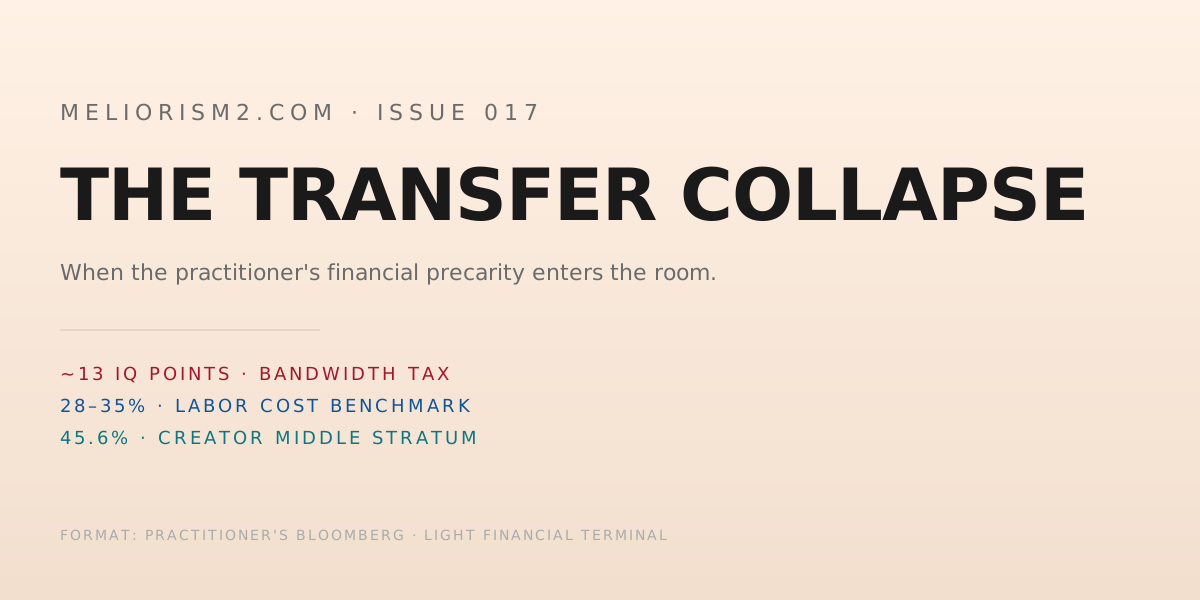
You are fully trained to hold space. You have the frameworks, the questions, the presence. What you may not have — in any given session — is full bandwidth. Because financial precarity doesn't stay in your bank account. It travels with you into the room.
This is the Transfer Collapse: the moment a practitioner's financial anxiety becomes invisible structure in the session. Shorter pauses before you speak. Less willingness to introduce the uncomfortable question. A tendency to deliver value quickly rather than let the client sit in productive discomfort. Not because you made a decision to do that. Because cognitive bandwidth is finite — and you spent some of it before the call began.
Today's briefing is not about earning more. It's about noticing what's already leaking — and building the financial floor that makes full presence possible.
We've been having the same argument for two thousand years. What's changed is that now the practitioner is often arguing it alone — with themselves — five minutes before a session begins.
The Bandwidth Tax: What the Scarcity Research Shows
In 2013, economists Sendhil Mullainathan and Eldar Shafir published Scarcity: Why Having Too Little Means So Much — a landmark study of what it actually costs to be poor. Their central finding was not what most people expected: financial scarcity doesn't just cause stress. It consumes cognitive capacity. When a person is actively worried about money, measurable working memory and fluid intelligence decrease — by approximately the equivalent of 13 IQ points, comparable to losing a full night's sleep. [1]
This is not a metaphor about distraction. It is a physiological claim about attention. The mental bandwidth required to manage financial uncertainty — calculating, worrying, suppressing worry, recalculating — is drawn from the same finite pool as the bandwidth required to be present with another human being.
Mullainathan and Shafir call the mechanism tunneling: under scarcity, the mind focuses narrowly on the immediate threat — and everything outside the tunnel becomes cognitively expensive to attend to. [1] For a practitioner, "everything outside the tunnel" includes: the client's affect, the pause that would open the next layer, the embodied signal that says slow down here.
What this means in session: the practitioner is not distracted in an obvious way. They are present. They ask good questions. They follow the protocol. What they lose is the expensive kind of attention — the peripheral, ambient reading of the room that distinguishes good facilitation from great facilitation.
The particularly insidious feature of the transfer collapse is that the practitioner cannot feel it happening. The research on scarcity shows that people under financial stress consistently overestimate their own cognitive performance — the tunnel feels like focus. This is why the collapse must be detected through behavior, not self-report. [1]
There is a second mechanism at work. Kahneman and Tversky's prospect theory establishes that losses are felt approximately 2–2.5x more intensely than equivalent gains. [2] For a financially precarious practitioner, the potential loss of a client — through challenge, confrontation, or a hard question that lands poorly — is felt far more acutely than any gain from the client's genuine growth. The practitioner begins, unconsciously, to optimize for client retention over client development. This is the deepest form of the transfer collapse.
Mise en Place as a Financial Discipline
The restaurant industry has a language for the practitioner's problem. It's called the cost structure. Every chef who runs a kitchen — not just cooks in one — learns to think in percentages. Labor cost should represent 28–35% of gross revenue. Food cost another 28–35%. Combined: the "prime cost." If your prime cost exceeds 65% of revenue, you are not running a restaurant. You are running a very busy way of losing money. [4]
What's notable is that this discipline is taught from the beginning of culinary training. No working chef manages a kitchen without knowing their food cost percentage. They run it weekly. The number is on the wall.
Most independent practitioners have no equivalent number. They know what they charge per hour. They may know how many clients they have. But they have not calculated: What is my actual cost of delivery — including preparation time, decompression time, administration, continuing education, and the unpaid hours that make the paid hours possible? What percentage of my revenue actually supports my living? If the chef who doesn't know their food cost percentage will eventually run out of margin, the practitioner who doesn't know their living cost percentage will eventually run out of presence.
Mise en place — the French kitchen term meaning "everything in its place" — is usually taught as an organizational philosophy: prep your ingredients before service, have your station ready, eliminate chaos before the rush. But experienced chefs describe it differently. Mise en place is, at root, a financial discipline. It is the act of knowing exactly what you have, what you need, and what the gap is — before service begins. A chef who arrives at service without having done mise en place is not just disorganized. They are entering a high-stakes performance with unknown inputs.
A practitioner who enters a session without a living income floor — a clear number they know their work needs to produce — is in the same position. Not disorganized. Entering with unknown inputs.
This week, before your next session, spend 10 minutes calculating your "kitchen number" — the revenue your practice needs to generate monthly for you to be financially secure enough to be fully present. Include:
- → Fixed costs (rent, software, insurance, professional memberships)
- → Variable costs per client (preparation time at your hourly rate, admin, follow-up)
- → Living expenses (housing, food, health, transport)
- → Professional investment (training, supervision, continuing education)
- → A margin for non-billable time (illness, rest, the sessions that run over)
That number is your living income threshold. It is not your ceiling. It is your floor — the financial mise en place that makes full presence possible.
The connection to Ariely's anchoring research is worth noting: practitioners who set prices without first calculating their living income threshold tend to anchor on market rates, on what they think the client will accept, or on what they themselves have always charged. These anchors are arbitrary — and, once set, become coherent. The price feels right because it's the price. The Scarcity research and the anchoring research together suggest a corrective: calculate your number first, anchor on that, then adjust for market reality. In that order. Not the reverse. [3]
Is Your Financial State Already in the Room?
The Transfer Collapse cannot be detected through self-report in the moment — that's the tunneling effect. It must be detected through pattern recognition after the fact. These are the five behavioral signals most commonly reported by practitioners who have later identified a period of financial stress leaking into their facilitation. Click each signal you've noticed in your own recent work.
-
✓Accelerating toward answers. You find yourself moving toward resolution more quickly than the content warrants — offering a reframe, a framework, or an interpretation before the client has fully arrived at the question themselves.
-
✓Avoiding the uncomfortable pivot. You notice a moment when a harder question would open something important — and you don't ask it. You tell yourself it wasn't the right time. It may not have been. But it may also have been a financial calculation wearing the clothes of professional judgment.
-
✓Filling silence with value delivery. You notice discomfort with the productive pause — the silence that does work. Instead, you fill it with content, with summaries, with useful things. The client feels served. The session feels efficient. The deeper process has been interrupted.
-
✓Over-performing on likability. You find yourself more charming, more agreeable, more affirming than the client's actual progress warrants. The session feels warm and successful. The client is not being challenged.
-
✓Post-session financial review intrusions. Within an hour after a session ends, you find your mind moving to revenue calculations, client count, upcoming invoices — before you've fully closed the session for yourself. The financial tunnel was running in parallel the entire time.
These signals can be difficult to distinguish from legitimate facilitation choices — and that difficulty is the point. The practitioner who is financially secure makes the same moves sometimes, for well-reasoned professional reasons. The practitioner under financial stress makes them more frequently, at lower thresholds, with less deliberate reasoning. The diagnostic is not about isolated incidents. It's about the pattern over time — and whether your financial state is one of the variables producing the pattern.
The Thought-Ratio Log
This experiment is drawn from cognitive load research methodology. The goal is not to eliminate financial thinking — it is to make it visible as a variable, so it can be managed rather than denied. One week. One session tracked per day (or per session, if you see fewer than 5 clients this week).
DATE: _____ · STRESS LEVEL: ___/5 · CLIENT TYPE: ____
TALLY: _____ · NOTE: ________________________________
The goal of the experiment is not guilt — it is calibration. A practitioner who knows their transfer pattern can design around it: a brief financial clarity ritual before sessions, living income pricing that removes the tunnel, supervision structure that holds the anxiety outside the room. None of these are available to a practitioner who doesn't know the pattern exists.
Cited Sources
Questions for This Issue
Non-profit practitioner intelligence. Fiscal sponsorship → 501(c)(3).
A percentage of Meliorism2.com proceeds supports Cherokee At Large Nation (San Francisco) and native communities.
↗ THE LIBRARY — ALL ISSUES · ⌂ CURRENT ISSUE