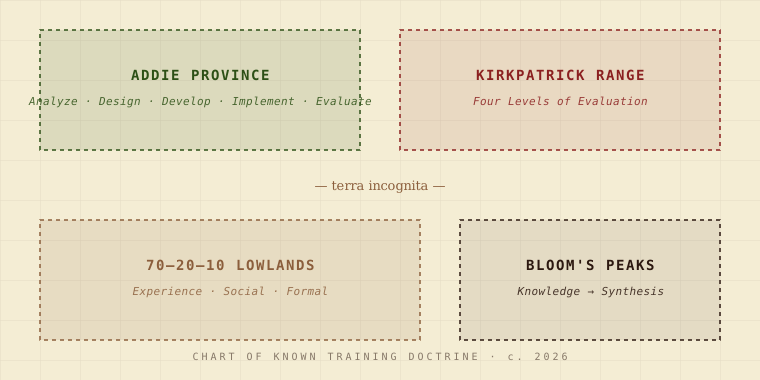
Alfred Korzybski coined the phrase in 1931, two years before his landmark work Science and Sanity went to press. He was a Polish-American philosopher and engineer — not an educator — and his concern was the way human nervous systems confuse symbolic representations with actual reality. His term for this confusion: semantic reactions. We don't just think with language; we respond to language as though it were the thing itself.
The word "dog" can trigger the same adrenaline response as an actual dog. The organizational chart triggers the same feelings of hierarchy as actual power dynamics. And ADDIE — the framework drawn in 1975 — triggers the same confidence as an actual evidence base.
Gregory Bateson extended Korzybski's observation into a second-order principle: the map is not just a simplification — it is a different kind of thing than the territory. A map of London is not London. It doesn't smell like rain, it doesn't have pubs, it doesn't have people in it. It is a symbolic artifact that operates by omission.
Every training framework is built on omission. ADDIE omits iteration. Kirkpatrick's Level 1 (participant satisfaction) omits its weak relationship with learning outcomes — meta-analyses since Alliger & Janak (1989) have found reaction and learning measures only weakly correlated, and Sitzmann et al. (2008) showed self-assessed enjoyment and actual learning often diverge in adult training contexts. The 70-20-10 model omits the evidence base, because there isn't one: the researchers who developed it in the 1980s explicitly warned that it was descriptive, not prescriptive.
Bateson called the confusion between map and territory "the pathology of epistemology." It isn't a knowledge problem. It's a thinking-about-knowledge problem — which means it doesn't get fixed by adding more information to the map.
In 1946, Jorge Luis Borges wrote a one-paragraph story — "On Exactitude in Science" — about an empire whose cartographers became so obsessed with precision that they built a map of the empire at 1:1 scale. A map the size of the thing itself. It was, of course, useless. Future generations found it rotting in desert ruins, the occasional shelter for travelers and animals.
Borges was writing satire, but the parable runs both ways. A perfect map is useless because it has no useful omissions. A perfect training system is useless for the same reason: it's so complete, so multi-modal, so assessment-rich that practitioners can't actually use it. The useful map is always an act of disciplined omission. The question is: which things have we agreed to omit without noticing?
In most training doctrine, we have omitted: emotional state, somatic readiness, social context, power differentials, implementation support, and time. What we have kept: content modules, assessment scores, and Level 1 reaction sheets.
In 1999, David Dunning and Justin Kruger published a deceptively simple study. People who performed poorly on tests of logical reasoning, grammar, and humor also dramatically overestimated their own performance. In Study 1 (humor judgment), bottom-quartile participants scored at roughly the 12th percentile and estimated they had scored at roughly the 62nd [4].
The standard reading is about confidence and incompetence. The deeper reading — the one practitioners need — is about map failure. The unskilled participant has a map of the skill domain. That map is wrong. But here's the mechanism: you can only use your map to evaluate your map. If your map is wrong, your evaluation of your map will also be wrong. This is not a character flaw. It is a structural problem.
It explains why practitioners who've learned ADDIE as their mental model of learning design cannot easily evaluate the limitations of ADDIE. The map assesses the map. Breaking this loop requires external input — which is exactly what brave spaces make possible.
"Safe spaces" ask people to bring who they are without challenge. Brave spaces ask something harder: bring your map, and be willing to have it wrong.
Arao and Clemens argued in 2013 that "safety" as a classroom contract often functions as comfort maintenance — it protects participants from the discomfort that learning actually requires. Brave spaces reframe this: the contract is not protection from challenge, it's commitment to staying in the room when challenge arrives.
For practitioners, the brave spaces act is specific: it means being willing to say, in front of participants, "the model I just taught you may be wrong." It means being willing to hear, from a participant with 25 years of frontline experience, that the map doesn't match their territory. And it means building sessions where participants can surface the gap without feeling like they're failing the trainer.
Chris Argyris called this "double-loop learning" — not just adjusting behavior within the existing map, but examining and revising the map itself. His research found that the people most resistant to this were high-performing professionals: people whose identity was most invested in their map being correct.
| THE MAP SAYS | → | THE TERRITORY IS |
|---|---|---|
| ADDIE is a linear process | → | Learning design is iterative, recursive, and frequently reversed. The map survived because linear is manageable, not because it's true. |
| 70-20-10 is a research-backed ratio | → | The ratio is descriptive, not prescriptive. The original researchers (Lombardo & Eichinger, 1996) warned against using it as a design principle. No replication study has validated the numbers. |
| Kirkpatrick Level 1 (satisfaction) predicts Level 2 (learning) | → | Satisfaction and learning are weakly to inversely correlated. Comfortable participants tend to learn less. The measurement persists because it's cheap and feels like evidence. |
| Bloom's Taxonomy is a hierarchy — knowledge before synthesis | → | Experts routinely skip levels. Problem-based and case-based methods that begin at "synthesis" have consistently outperformed knowledge-first sequencing. The pyramid is a pedagogical convenience, not a cognitive law. |
| Transfer happens when content is well-designed | → | Transfer research since 1901 (Thorndike & Woodworth) consistently finds that transfer is situational, context-sensitive, and frequently fails when the environment doesn't match training conditions. |
| More content = more learning | → | Cognitive load theory (Sweller, 1988) establishes that working memory capacity is finite. Past a threshold, more content reduces learning. The map adds; the territory limits. |
The Meliorist principle here is not "abandon the frameworks." Maps are useful. ADDIE gets projects through gate reviews. Kirkpatrick gives organizations a language for evaluation. Bloom's gives curriculum designers a starting scaffold.
The Meliorist principle is stewardship: hold the map lightly and the territory faithfully. The framework is a tool for entry; the participant's actual experience of learning is the territory you're responsible for. Those two things sometimes match. More often, there's a gap. The constructive steward names the gap without abandoning the tool.
Peter Senge called this "creative tension" — the gap between vision (the map you aspire to) and current reality (the territory as it is). The tension is not a problem to be resolved by updating the map to say what you want. It's the engine of learning — for your participants and for you.
- [1] Korzybski, A. (1933). Science and Sanity: An Introduction to Non-Aristotelian Systems and General Semantics. Science Press. — The source. Dense, rewarding, frequently misquoted.
- [2] Bateson, G. (1972). Steps to an Ecology of Mind. University of Chicago Press. — The philosophical extension. Start with "Form, Substance, and Difference."
- [3] Borges, J.L. (1946). "On Exactitude in Science." In El Hacedor (1960). — One paragraph. Read it twice.
- [4] Kruger, J. & Dunning, D. (1999). Unskilled and unaware of it: How difficulties in recognizing one's own incompetence lead to inflated self-assessments. Journal of Personality and Social Psychology, 77(6), 1121–1134. DOI: 10.1037/0022-3514.77.6.1121. — Study 1 (humor): bottom-quartile mean actual percentile ≈ 12, mean self-estimated percentile ≈ 62.
- [5] Argyris, C. (1991). Teaching Smart People How to Learn. Harvard Business Review, 69(3), 99–109. — The seminal account of why professionals resist double-loop learning.
- [6] Arao, B. & Clemens, K. (2013). From Safe Spaces to Brave Spaces: A New Way to Frame Dialogue Around Diversity and Social Justice. In The Art of Effective Facilitation. Stylus Publishing. — Reframes the practitioner's contract with participants.
- [7] Senge, P. (1990). The Fifth Discipline: The Art and Practice of the Learning Organization. Doubleday. — "Creative tension" and the systems view of organizational learning.
- [8] Thalheimer, W. (2018). The 70-20-10 Rule: Research, History, and Guidance. Work-Learning Research. — The definitive audit of the 70-20-10 evidence base.
- [9] Alliger, G. M. & Janak, E. A. (1989). Kirkpatrick's levels of training criteria: Thirty years later. Personnel Psychology, 42(2), 331–342. — Foundational meta-analysis: reaction (Level 1) and learning (Level 2) measures correlate only weakly.
- [10] Sitzmann, T., Brown, K. G., Casper, W. J., Ely, K., & Zimmerman, R. D. (2008). A review and meta-analysis of the nomological network of trainee reactions. Journal of Applied Psychology, 93(2), 280–295. — Self-assessed enjoyment and actual learning often diverge; satisfaction is not a proxy for transfer.